
AI Cost Management and the Hidden Financial Risks Inside Modern Teams
AI cost management has become one of the biggest challenges for companies adopting artificial intelligence across multiple departments. Even organizations with strong financial discipline often experience sudden increases in spending once employees gain access to various AI tools. These increases are not always caused by misuse or irresponsible behavior. They often occur because AI cost management is nearly impossible without structure. As teams rely on AI for writing coding analysis planning and communication the volume of usage multiplies. Each model has different pricing rules each platform tracks usage differently and individual employees behave in unpredictable ways. This article analyzes the fundamental causes behind failing AI cost management and explains why only centralization can create stable long term control.
The roots of ineffective AI cost management in modern organizations
Every prompt every request and every piece of output contributes to cost. Independent research such as the McKinsey analysis on the economic potential of generative AI shows that companies consistently underestimate how quickly usage scales when AI becomes part of daily workflows.
Most companies begin their AI adoption with the same assumption. They expect moderate usage and predictable costs. Employees are encouraged to experiment lightly with tools that help them complete tasks faster. Over time every organization discovers that AI cost management does not behave like traditional software spending. Unlike fixed license software artificial intelligence operates on consumption. Every prompt every request and every piece of output contributes to cost.
The first reason why AI cost management breaks down is fragmentation. Employees use different tools. Some rely on model provider websites. Others install extensions. Some use API keys directly. Departments often use different platforms depending on their workflows. Each of these tools generates its own usage log and its own billing cycle. Finance teams cannot easily combine this data. Managers do not see what is happening until it becomes expensive.
The second reason is invisibility. AI cost management requires real time insight into usage but most companies only receive invoices at the end of the month. By that time budgets have already been exceeded. Since there is no daily oversight managers cannot adjust behavior or set limits.
AI cost management requires real time insight into usage but most companies only receive invoices at the end of the month. This lack of visibility is one of the core reasons budgets break down, and we explained this more deeply in our article on AI usage monitoring where visibility becomes the foundation of safe and scalable AI adoption.
The third reason is the rapid growth of demand. Once employees discover the benefits of AI they start using it frequently. This growth is natural and productive but it also increases token consumption. Without centralized controls AI cost management becomes reactive instead of strategic.
Behavioral patterns that disrupt AI cost management inside teams
Artificial intelligence introduces a new type of user behavior. Employees often rely on AI as a continuous assistant. They use it to draft messages help plan projects summarize meetings generate reports organize ideas and produce code. Most of these tasks feel small but when multiplied across a team the usage becomes enormous.
Another behavioral pattern affecting AI cost management is the dopamine loop. AI provides instant value which encourages more usage. As employees finish tasks faster they return to AI tools for additional help. Because the benefits are immediate employees rarely consider the financial impact.
In addition to psychological factors there is also the effect of perceived unlimited capacity. Employees assume that AI resources are effectively infinite. When they use an AI model they do not see the cost impact directly. This disconnect between effort and spending makes AI cost management significantly harder.
Why multiple models complicate AI cost management
Modern teams rarely rely on a single model. They select specific models depending on their purpose. Some models are better for reasoning some for writing some for coding and some for fast lightweight tasks. This multi model environment makes AI cost management even more complex because each model follows its own pricing logic.
Some models are priced per input token others per output token. Some models charge more for large context windows. Some offer accelerated versions with higher cost per request. Image processing document parsing and code generation often include additional pricing layers.
Without a centralized way to compare model usage AI cost management becomes a guessing game. Finance teams cannot predict future expenses because usage is inconsistent between departments and between employees. Even experienced managers cannot manually track multiple models without an integrated system.
Operational risks that appear when AI cost management is decentralized
Financial unpredictability is not the only consequence of poor AI cost management. There are deeper operational risks that affect performance and security.
One risk is inconsistent quality. When employees choose different AI tools without guidance the quality of analysis writing or coding varies widely. This creates confusion and additional review work which indirectly increases cost.
Another risk is data exposure. AI cost management is closely connected to data governance. When employees use external tools on their own accounts sensitive information can leave the organization without proper oversight. This creates compliance concerns and long term security liabilities.
A third risk is knowledge loss. When work is done across scattered tools conversations and insights remain locked inside personal accounts. When an employee leaves the company the knowledge disappears with them. A centralized system supporting AI cost management prevents this by storing everything in one shared environment.
Why traditional budgeting methods fail in AI cost management
Most companies approach AI cost management using traditional budgeting techniques. They estimate monthly usage based on team size or expected demand. Unfortunately AI behaves differently from linear systems. Usage does not scale evenly. Some teams rely on AI heavily during specific periods while others use it intensively only when handling complex tasks.
Another flaw in traditional budgeting is the fantasy of fixed cost. Since AI usage is dynamic spending cannot be forecasted using static rules. Without unified reporting companies lack the data needed to build accurate predictions.
The final limitation is manual reporting. When employees submit AI expenses manually the data is delayed incomplete and often inaccurate. AI cost management cannot rely on spreadsheets and manual records. It requires automated real time tracking.
Why centralization is the foundation of effective AI cost management
After analyzing financial psychological and operational factors the conclusion becomes clear. AI cost management is impossible without centralization. A single environment for AI usage fundamentally changes how teams interact with models and how the organization monitors expenses.
Centralization provides several key advantages.
Managers gain real time visibility into AI activity.
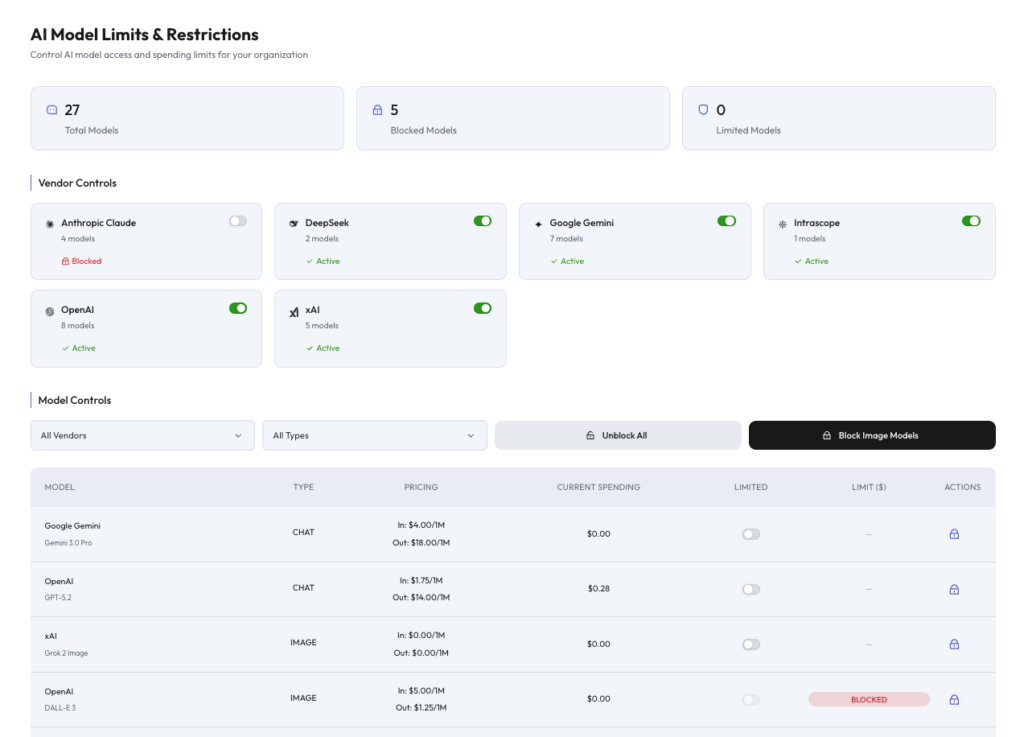
Usage limits can be assigned per user per team or per project.
Costs are predictable because the entire system feeds into a unified dashboard.
Data policies can be enforced consistently across all users.
Knowledge remains preserved regardless of employee turnover.
Teams benefit from standardized workflows which reduce redundant or wasteful prompts.
Model selection becomes intentional instead of random improving both quality and cost efficiency.
All these factors combined make AI cost management stable sustainable and predictable.
Strategic benefits of centralization for long term AI cost management
Centralized AI cost management does more than control spending. It transforms how teams work. One important benefit is process alignment. When AI usage flows through the same environment employees follow similar workflows which improves communication and reduces duplication of effort.
Another benefit is optimization. When managers see which models are used excessively they can shift teams toward more efficient alternatives. This creates a balanced system where advanced models are reserved for high value tasks and lighter models handle daily work.
A third benefit is accurate forecasting. Centralization generates clean historical data which allows companies to predict how usage and cost will evolve. This elevates AI cost management from reactive oversight to proactive planning.
Conclusion connecting AI cost management with Intrascope
The research clearly shows that organizations struggle with AI cost management when usage is fragmented. Financial unpredictability emerges from scattered tools independent employee accounts and inconsistent model selection. Behavioral patterns accelerate consumption and poor visibility hides the real cost until it is too late.
Intrascope solves these problems by centralizing all AI usage inside a single secure workspace. With real time visibility clear limits multi model control and shared knowledge Intrascope turns AI cost management into an organized predictable and sustainable process.