
AI Usage Monitoring and the New Reality of Managing Intelligent Workflows
AI usage monitoring has emerged as one of the most critical components of modern AI adoption. As organizations accelerate their use of artificial intelligence across writing coding research communication and decision support the need for real time insight becomes unavoidable. Without AI usage monitoring companies cannot understand how much they spend how employees behave which models influence key decisions and where potential security risks appear. Many teams believe that simple monthly invoices or ad hoc tracking are enough. In reality AI usage monitoring requires a deeper structured approach in order to maintain productivity accuracy security and cost stability.
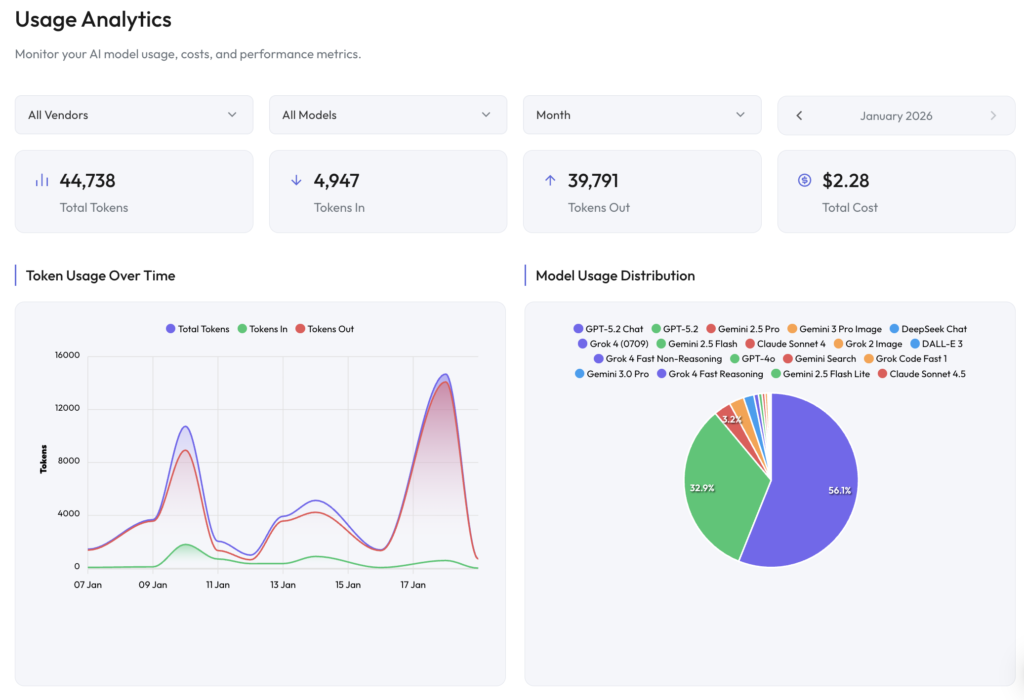
Why AI usage monitoring fails when organizations rely on scattered tools
Global frameworks such as the OECD AI Principles emphasize transparency, accountability and responsible oversight as core requirements for any organization using AI systems. Without proper visibility into usage and data flows, companies cannot meet even the basic expectations of these standards.
Most companies that struggle with AI cost or AI risk have the same foundational weakness. They lack centralized AI usage monitoring. Employees use different tools some through web interfaces some through browser extensions some through unofficial plugins and some through direct API keys. Every tool generates separate logs usage patterns and cost records. Managers cannot combine this data and therefore cannot understand what is happening inside the organization until it becomes expensive or dangerous.
Another problem is delayed visibility. When AI usage monitoring depends on end of month billing companies only discover problems after they occur. If a team consumes large amounts of tokens during a product sprint the invoice arrives weeks later. At that point budgets are already exceeded and the organization has no chance to react in time.
A third problem is the lack of behavioral insights. Without proper AI usage monitoring companies cannot analyze which teams rely heavily on AI why certain tasks generate more consumption or how workflows evolve. This leaves leadership without the information needed to optimize processes or improve efficiency.
The psychological and organizational factors that make AI usage monitoring essential
AI produces immediate value which encourages employees to use it frequently. This is good for productivity but dangerous for AI usage monitoring if no structure exists. When the reward is instant people rarely consider cost or security. They focus only on the benefit. This leads to natural overuse and unpredictable consumption patterns.
Another factor is habit formation. Once employees realize how much time AI saves they begin using it reflexively. They rely on it for planning writing reviewing summarizing brainstorming and analysis. These habits compound daily and monthly. Without AI usage monitoring organizations lose control over the scale of consumption and cannot accurately plan budgets or staffing.
AI also generates invisible work. Many tasks that were once manual are now completed instantly by the model. This hides the true workload distribution inside the organization. AI usage monitoring becomes necessary to detect how much effort the AI is contributing to each department and how this changes business operations.
How AI usage monitoring improves accuracy and decision quality
Artificial intelligence influences key business decisions. It shapes documents strategies code structures analytical insights and creative direction. Without AI usage monitoring leadership cannot know which AI models were used for which decisions and whether those models were suitable for the task.
Strong AI usage monitoring reveals patterns such as which models provide the best reasoning which models perform poorly and which tasks require validation by another system. When a company knows exactly how models are used it can refine workflows improve accuracy and reduce the risk of flawed outputs shaping important strategic choices.
AI usage monitoring also allows organizations to identify contradictions between model outputs. When multiple employees use different models without oversight the organization may experience inconsistencies in tone structure or factual accuracy. Monitoring highlights these disparities and enables leadership to implement standardized practices.
Why AI usage monitoring is essential for data security and compliance
Security is one of the strongest arguments for AI usage monitoring. When employees use AI tools without oversight they may unknowingly share internal information with external platforms. This exposes the company to risks including data leaks regulatory violations and compliance failures.
AI usage monitoring ensures that leadership understands exactly which data enters the AI system and under which conditions. It also helps enforce security rules such as prohibiting certain forms of content from being processed by external providers or routing sensitive tasks through approved models only.
AI usage monitoring also proves valuable during audits. Companies increasingly face questions from clients and regulators regarding how AI is used and how decisions are made. Only centralized AI usage monitoring can provide accurate historical data that answers these questions reliably.
How AI usage monitoring stabilizes cost and prevents financial overspending
Costs in artificial intelligence grow quickly when there is no AI usage monitoring. Even small tasks accumulate significant usage over time. A few intensive projects can double monthly spending without warning. When employees test advanced models output large contexts generate code frequently or upload documents the organization may experience sudden cost spikes.
AI usage monitoring solves this by giving managers real time insight into spending. Instead of reacting to invoices leadership can intervene immediately adjust model access set usage limits or reorganize workflows.
Strong AI usage monitoring also reveals which teams benefit the most from AI and which teams use it inefficiently. This allows organizations to optimize model selection reduce waste and shift employees toward cost efficient workflows.
How AI usage monitoring influences team behavior and productivity
When teams know that AI usage monitoring is active they naturally develop more intentional behavior. Employees begin to think about which model they should use for each task. They reflect on how many requests they generate. They become more aware of the cost and the organizational impact of their workflows.
This is not surveillance. It is optimization. AI usage monitoring helps teams collaborate more effectively by showing them where automation succeeds where models produce inconsistent results and where workflows require refinement.
AI usage monitoring also encourages shared understanding. When all employees see transparent usage patterns they learn from one another and adopt best practices. This strengthens the entire organization.
Why AI usage monitoring requires a unified environment
Without centralization AI usage monitoring is almost impossible. When employees use multiple tools each with its own tracking system no amount of manual reporting can produce accurate insight. Logs become scattered data becomes inconsistent and leadership cannot derive meaningful conclusions.
A unified environment consolidates all activity by design. Every model request every conversation every project and every usage pattern becomes visible from one dashboard. This transforms AI usage monitoring from a chaotic process into a structured and reliable system.
Centralization also supports access control. Organizations can specify which employees use which models and under which conditions. This directly enhances both security and efficiency.
How AI usage monitoring enhances long term organizational intelligence
AI usage monitoring is not only a tool for today. It is a foundation for future intelligence. When usage is tracked historically organizations build a detailed understanding of how artificial intelligence contributes to real outcomes. This allows leadership to plan future investments predict resource needs and refine workflows.
Historical AI usage monitoring also reveals long term trends. Leadership can identify which departments rely most on AI which tasks generate the highest value and which areas require additional training. This shapes strategic planning and improves organizational maturity.
Over time AI usage monitoring builds an internal knowledge map that becomes one of the company’s strongest assets.
Conclusion connecting AI usage monitoring with Intrascope
AI usage monitoring has moved from a nice to have capability to a foundational requirement for every company adopting artificial intelligence. Without the ability to monitor usage in real time organizations face financial unpredictability security risks knowledge loss and inconsistent quality.
Intrascope provides a unified environment where AI usage monitoring becomes effortless accurate and deeply integrated into daily work. It offers real time insight into model activity per user per team and per project. It preserves knowledge enforces security rules maintains cost stability and improves overall organizational intelligence.
With Intrascope companies turn AI usage monitoring into a strategic advantage that makes their teams faster safer and more aligned.