
Secure AI Environment and the New Standard for Safe Intelligent Workflows
A secure AI environment has become a fundamental requirement for every organization that uses artificial intelligence in daily operations. Early AI adoption often focused on speed creativity and productivity but as usage scaled security concerns quickly appeared. Employees began submitting sensitive information into external tools model logs became scattered and companies struggled to understand where their data was going. As a result leadership teams now recognize that a secure AI environment is essential for protecting the organization and maintaining long term operational stability.
Why modern organizations cannot operate without a secure AI environment
Artificial intelligence models depend on the data they receive. Employees often copy text from internal documents emails reports and codebases into AI tools. When this happens in a non secure setting the organization cannot control where the information travels or how it is stored. This creates a major vulnerability.
A secure AI environment prevents unintentional data leakage by centralizing all AI usage within a controlled system. Instead of using multiple external websites and extensions employees work inside a protected workspace designed to enforce company policies. This eliminates the risk of sensitive information being processed by unauthorized tools.
Another reason organizations need a secure AI environment is the rapid expansion of AI usage. As every department begins integrating AI into its operations the risk grows exponentially. Without central protection the attack surface widens and the organization becomes more vulnerable to breaches human error and miscommunication.
How employee behavior creates security challenges without a secure AI environment
Employees often use artificial intelligence in ways that leadership does not expect. They rely on AI assistants for writing emails drafting documents preparing reports debugging code and interpreting data. In many cases they paste content that contains client information internal strategy product details proprietary algorithms or legal material.
When employees use external tools independently the organization loses visibility. Without a secure AI environment managers cannot see what information is being submitted and cannot enforce protective rules. Employees rarely act with malicious intent but their natural desire to complete tasks quickly can lead to accidental exposure of critical information.
A secure AI environment solves this problem by guiding behavior. It provides employees with the tools they need while ensuring that data never leaves an authorized space. This maintains both productivity and safety.
Why a secure AI environment is essential for regulatory and contractual compliance
Many companies operate under strict regulations related to data privacy confidentiality and information management. This includes industries such as finance healthcare government technology consulting and legal services. Using AI without a secure AI environment can lead to compliance violations even if employees do not realize it.
Global standards such as the National Institute of Standards and Technology AI Risk Management Framework provide clear guidance on how organizations should structure governance visibility and security when working with AI systems, and all of these principles rely on having a controlled and centralized environment.
A secure AI environment ensures that AI usage aligns with regulatory standards. It limits where data can be processed controls how information is stored and prevents exposure to external platforms without approval.
How a secure AI environment improves data governance and organizational control
Data governance refers to the rules processes and responsibilities that determine how information flows within a company. AI introduces a new layer of complexity because it transforms unstructured data into actionable insights. Without a secure AI environment leadership cannot track how information moves or how decisions are influenced.
A secure AI environment centralizes information pathways. It allows managers to see which models employees interact with which data sources they use and which tasks rely heavily on AI assistance. This creates clarity and control. Leaders can enforce boundaries, restrict access to sensitive resources and implement approval workflows when necessary.
This level of data governance is impossible when employees use external tools scattered across personal accounts. Only a secure AI environment ensures consistent policy enforcement.
How a secure AI environment protects intellectual property
Intellectual property is one of the most valuable assets inside any organization. It includes processes, algorithms, product strategies, research notes, creative concepts and operational knowledge. When employees use unregulated AI tools they may unknowingly share intellectual property with third party systems.
A secure AI environment prevents this by isolating company work from external platforms and ensuring that intellectual property is processed only inside trusted infrastructure. This protects competitive advantage and prevents long term damage that may result from exposing proprietary information.
It also guarantees that generated content belongs exclusively to the organization. Without a secure AI environment third party platforms may retain data or use it to train future models unless explicitly prohibited.
How a secure AI environment improves consistency and accuracy across teams
Security is not only about protection but also about reliability. When employees rely on multiple unregulated tools the organization experiences a lack of consistency. Each tool may use different models, different versions and different rules for processing data. This causes inconsistencies in tone, reasoning, decision making and communication.
A secure AI environment standardizes which models employees use for which tasks. This creates unified output quality across the organization. It also ensures that all tasks follow the same guidelines, which improves accuracy and makes collaboration smoother.
Without a secure AI environment teams operate in silos. With it, they operate in alignment.
Why a secure AI environment strengthens knowledge retention
Knowledge retention becomes one of the biggest operational benefits of a secure AI environment. When employees use external AI tools their conversation history workflows and insights remain stored in personal accounts that the organization cannot access. When an employee leaves the company that information is lost permanently.
A secure AI environment consolidates all AI generated knowledge inside one protected system. This creates a powerful internal intelligence repository that grows with every task. Over time the organization accumulates a library of insights that can be reused by others. New employees learn faster because the secure AI environment contains structured historical context for every major project.
This increases long term efficiency and reduces dependency on individual employees.
Why a secure AI environment must be centralized rather than scattered
Fragmented tools create confusion, inconsistency and risk. Even if employees intend to follow guidelines scattered workflows make it impossible to enforce security. A secure AI environment requires centralization because it must control the entire path from input to output.
Centralization allows a secure AI environment to provide:
- full visibility
- consistent enforcement of data rules
- unified model access
- controlled collaboration
- standardized workflows
- knowledge preservation
- cost management
- compliance protection
Only a unified system can offer this level of protection at scale. Fragmented tools cannot maintain security because they operate outside organizational control.
How a secure AI environment improves operational stability and reduces risk
Operational stability depends on predictability. When companies lack a secure AI environment decisions are made inside tools the organization does not control. This exposes the company to hidden risks including incorrect outputs due to outdated models or unknown model behavior that affects business outcomes.
A secure AI environment ensures that all tasks flow through approved systems that remain monitored updated and controlled by the organization. This reduces errors improves trust and strengthens decision making.
It also reduces financial volatility. Secure centralized environments typically include cost monitoring features that detect unusual activity early and prevent overspending.
Conclusion connecting secure AI environment with Intrascope
A secure AI environment is no longer optional for modern organizations. It protects sensitive information strengthens governance ensures compliance preserves intellectual property and improves overall stability. Without a secure AI environment companies expose themselves to unnecessary risk and lose control over their data and decision making processes.
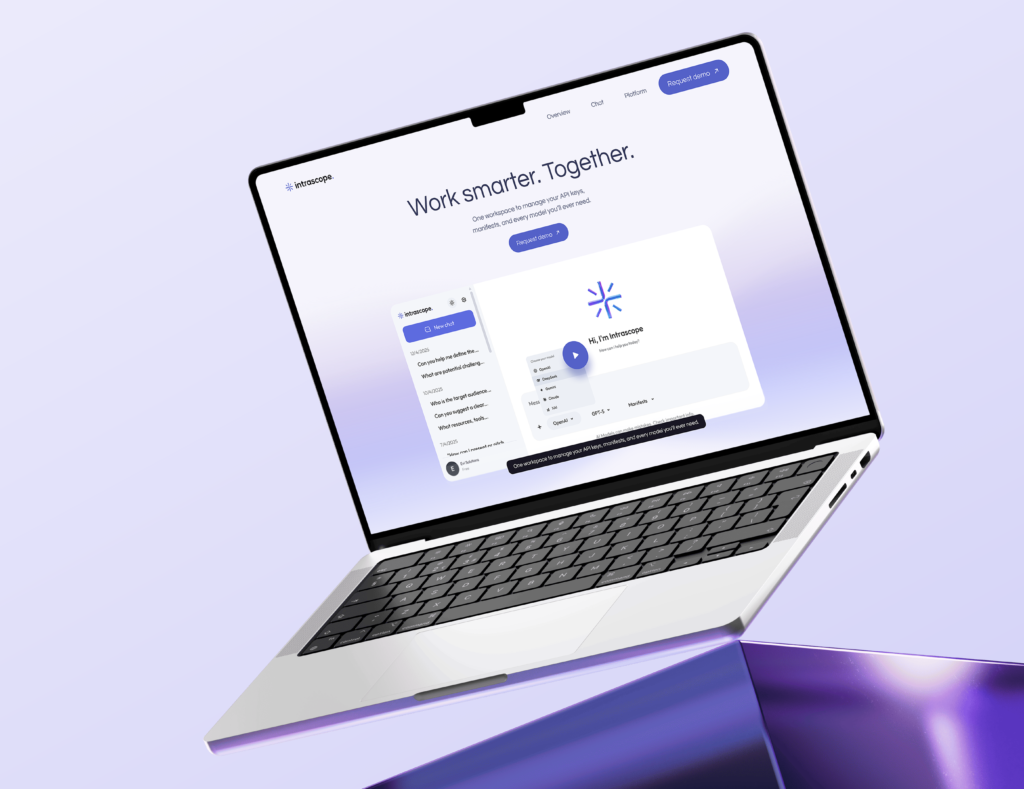
Intrascope provides a fully secure AI environment where all model usage knowledge collaboration and reasoning live inside one protected space. It allows companies to benefit from artificial intelligence safely with complete visibility predictable cost and centralized control. By offering a secure AI environment Intrascope ensures that organizations can scale AI usage confidently and responsibly.