Blog/·Updated
What Is an AI Manifest in Intrascope and Why It Changes How Teams Use AI
By Vladimir Krstic, Founder at Intrascope
Most teams don’t struggle with AI because the models are bad.
They struggle because context is missing.
Questions get repeated. Prompts live in private chats. Important decisions disappear after a conversation ends. New teammates start from zero. Over time, AI becomes a collection of isolated chats instead of a shared system.
That’s exactly the problem Manifests solve in Intrascope.
What Is a Manifest?
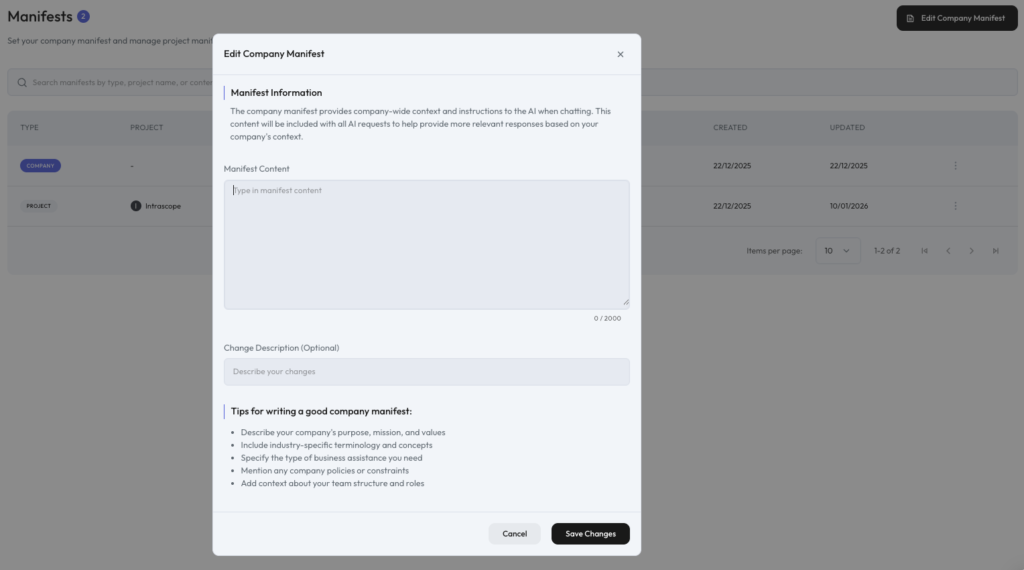
In Intrascope, a Manifest is a shared, persistent context layer for a project.
Think of it as a living document that defines:
- what the project is about
- how AI should behave in this context
- what rules, assumptions, and constraints apply
- what knowledge should always be remembered
Unlike a normal prompt, a Manifest is not temporary and not user-specific.
It belongs to the project and is shared across the entire team.
Every AI interaction inside that project uses the Manifest automatically.
Why Traditional AI Chats Break Team Context
Most AI tools similar to ChatGPT work like this:
- one user
- one chat
- one short-lived context
As soon as the chat ends, the context is gone.
This creates real problems for teams:
- different people ask the same questions in different ways
- AI responses drift over time
- decisions are not reusable
- onboarding new team members takes longer
- knowledge lives in screenshots and copy-pasted notes
AI becomes helpful, but not reliable at scale.
How Manifests Create Shared Team Context
A Manifest solves this by acting as a single source of truth for AI.
When an admin or team lead creates a Manifest, they define:
- project goals
- preferred tone and output format
- domain-specific knowledge
- do’s and don’ts
- references, summaries, and past decisions
Every team member working on that project automatically benefits from this context, without needing to restate it.
No prompt engineering.
No remembering “how we talked to the AI last time.”
Manifests Are Updated Over Time
Manifests are not static.
After a chat, users can:
- summarize the conversation
- extract key decisions
- add important outcomes back into the Manifest
This means the Manifest evolves with the project.
Each interaction makes the AI smarter for the next person who uses it.
Over time, the Manifest becomes:
- institutional memory
- onboarding documentation
- AI instruction manual
- knowledge base
All in one.
One Manifest, Many People, One Consistent AI
With Manifests:
- different team members get consistent answers
- AI responses stay aligned with project goals
- tone and structure remain stable
- knowledge doesn’t fragment
This is especially valuable for:
- marketing teams
- agencies
- product teams
- support teams
- non-technical users
Everyone gets the same AI behavior without learning how to prompt.
Security and Control at the Manifest Level
Manifests also work within Intrascope’s security model.
Admins can:
- control who has access to which project
- ensure sensitive context stays inside the team
The Manifest never leaves your workspace and is never used for model training.
Why Manifests Reduce Costs
Better context means:
- fewer repeated prompts
- shorter conversations
- less trial-and-error
- fewer wasted tokens
Teams using shared Manifests often reduce AI usage dramatically, sometimes by over 80%, depending on models and workflows.
AI becomes intentional instead of experimental.
Manifest vs Prompt Templates
Prompt templates help individuals.
Manifests help teams.
Prompt templates:
- are static
- are copied per user
- don’t evolve automatically
Manifests:
- are shared
- are persistent
- evolve with real work
- store decisions, not just instructions
That’s the difference between a tool and a system.
Final Thoughts
Manifests are the core reason Intrascope is not just another AI chat.
They turn AI from a collection of ad-hoc conversations into a shared team platform with memory, structure, and continuity.
If your team uses AI daily and keeps losing context, repeating work, or restarting conversations, the problem isn’t the model.
It’s the missing Manifest.
Intrascope for teams
Give your team one shared AI workspace instead of scattered accounts
Centralize model access, projects, manifests, and usage visibility. Start with a free trial or book a short walkthrough with our team.
7-day free trial · No credit card required
Closer to this topic: create reusable AI context.
Related articles