Blog/·Updated
Why API Access Is Safer and Cheaper Than AI Subscriptions for Teams
By Vladimir Krstic, Founder at Intrascope
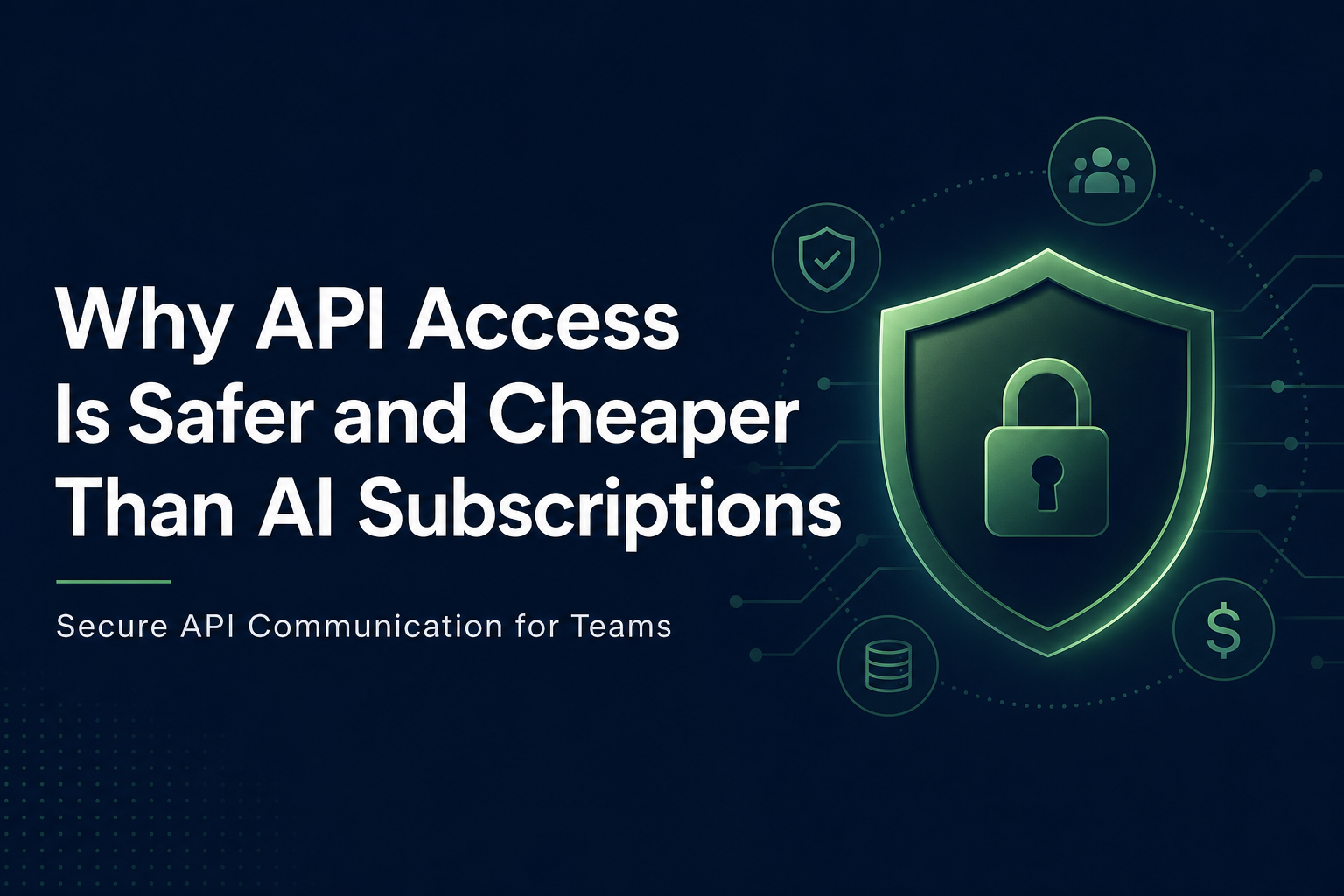
Most companies start with ChatGPT Plus or Claude Pro subscriptions because they are easy. For individuals, that makes sense. For organizations handling client data, internal documents, and proprietary knowledge, API access through a managed workspace is a fundamentally different and safer model.
This article explains why API-based AI usage gives enterprises better data control, clearer cost structure, and lower total spend than per-seat consumer subscriptions.
Consumer subscriptions vs API access: what changes
A consumer AI subscription is a personal product. You log in, chat in a browser, and pay a fixed monthly fee. An API connection is infrastructure. Your company sends structured requests to a provider, pays for tokens consumed, and keeps control over where those requests originate.
| Area | Consumer subscription (Plus / Pro / Team) | API access via Intrascope |
|---|---|---|
| Account ownership | Often tied to personal or semi-personal accounts | Company-owned keys in a managed workspace |
| Data location | Chat history in provider consumer environment | Work stays inside your isolated workspace |
| Billing | Fixed per-seat price regardless of usage | Pay only for tokens actually consumed |
| Visibility | Limited team-level insight | Usage analytics by user, project, and model |
| Access control | Shared passwords or scattered accounts | Centralized roles, permissions, and limits |
| Model choice | Locked to provider default plans | Route tasks to the right model per request |
Why API communication is safer for company data
1. Knowledge does not live in private accounts
When employees use personal ChatGPT or Claude accounts for work, company knowledge ends up in places IT cannot manage. Client briefs, internal strategy, product roadmaps, and support transcripts sit in individual chat histories. If someone leaves the company, that context leaves with them.
With API access through Intrascope, work happens inside a company workspace. Conversations, manifests, and project context stay under organizational control. Access can be revoked without losing company data to a personal login.
2. API keys are managed, not shared
Shared passwords are one of the most common enterprise AI risks. API access removes that pattern. Admins connect provider keys once. Keys are encrypted, never re-exposed in the frontend, and used only when users explicitly run a request. Read more in our guide on how Intrascope keeps API keys secure.
3. Clearer data boundaries with providers
Major AI providers treat API traffic under enterprise API terms, separate from consumer product policies. Requests go through authenticated API channels with defined data handling rules. Combined with workspace isolation, this gives security and compliance teams a model they can actually evaluate.
4. No shadow AI across personal tools
When the official path is slower or unavailable, employees open personal accounts. API-based access inside a governed workspace gives teams a better default. People stop routing sensitive work through unmanaged channels because the approved environment is already there.
Why API usage is cheaper than subscriptions at team scale
Subscriptions charge per seat. API billing charges per token. That difference matters enormously once you look at real usage patterns.
Light users are not subsidizing power users
In most teams, 70% of people use AI lightly. They write a few prompts per day: a summary, a rewrite, a quick answer. On a $20–30/month subscription, each of those users pays full price even if they consume a fraction of that value in tokens.
Realistic math for light daily usage
Assume a team member runs 3 prompts per day, averaging 2,000 tokens per prompt (input + output combined). That is 6,000 tokens per day, or roughly 180,000 tokens per month.
On an efficient mid-tier or lightweight model, that often costs well under one dollar per month per person. Seven light users might collectively cost a few dollars in API usage, not $140–210 in subscriptions.
Heavy users still cost less with model routing
Power users do consume more tokens. But even they benefit when simple tasks run on cheaper models and premium models are reserved for high-stakes work. Orchestration and shared Manifests reduce repeated context, which further lowers token volume.
How overall consumption actually goes down
Moving from subscriptions to API usage is not just a billing change. It changes behavior in ways that reduce waste.
- Shorter prompts — shared context in Manifests means less retyping background information
- Right model per task — summaries do not burn premium model tokens
- Visible spend — teams notice when usage spikes and adjust workflows
- No empty seats — you do not pay for people who barely use AI
- Centralized limits — admins can cap model access before costs drift
For a detailed cost breakdown, see AI cost optimization for teams.
When subscriptions still make sense
Consumer subscriptions are fine for individuals, students, and solo creators. They are less ideal when multiple employees handle company data, when finance needs predictable visibility, or when you need project separation across clients and departments.
At that point, API access inside a workspace is not a technical luxury. It is the operational model enterprises need.
Conclusion
API access is safer because company knowledge stays in a managed environment with encrypted keys and clear boundaries. For the deeper privacy angle (consumer chat vs API training defaults), read why AI API access keeps company data out of model training. API access is cheaper because you pay for usage, light daily prompts cost almost nothing in tokens, and total consumption drops when teams stop repeating context and misusing expensive models.
Intrascope is built to make that model practical for everyday teams, not only for developers.
Intrascope for teams
Give your team one shared AI workspace instead of scattered accounts
Centralize model access, projects, manifests, and usage visibility. Start with a free trial or book a short walkthrough with our team.
7-day free trial · No credit card required
Closer to this topic: connect your company API keys.
Related articles