Blog/
Intrascope vs Dust: AI Agents on Company Data vs a Shared Team Workspace
By Vladimir Krstic, Founder at Intrascope
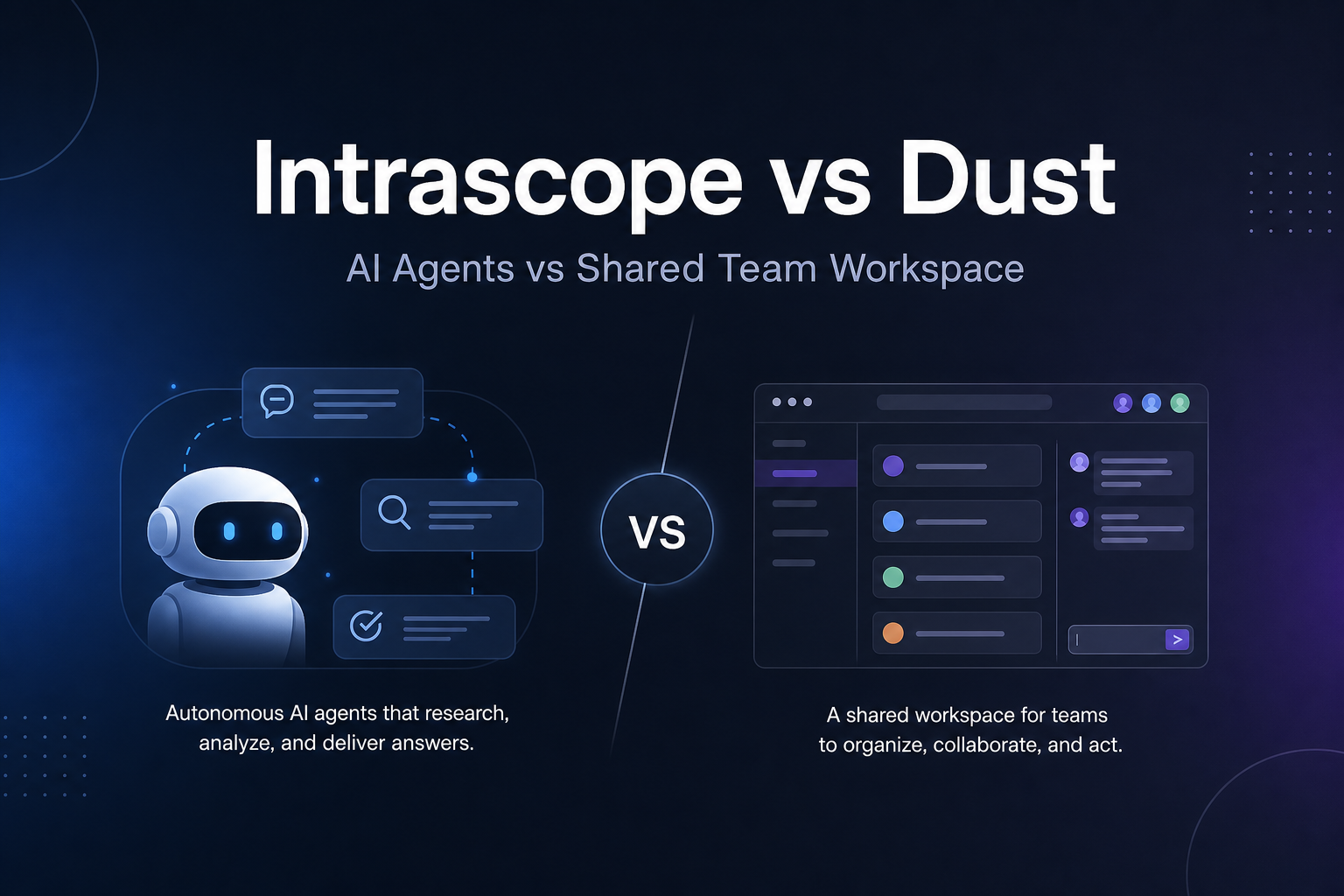
Intrascope vs Dust compares two platforms aimed at teams, but with different centers of gravity. Dust focuses on AI agents connected to company data and internal tools. Intrascope focuses on a shared AI workspace where teams manage models, projects, context, and usage across everyday work.
They are not always direct substitutes. Many companies evaluate both because they solve overlapping but distinct problems.
What Dust does well
Dust helps teams build and deploy AI agents that connect to internal knowledge sources such as Notion, Slack, Google Drive, and GitHub. It is strong for automating internal Q&A, support workflows, and knowledge retrieval inside existing systems.
- AI agents with connectors to company data sources
- Workflow automation across internal tools
- Useful for internal knowledge search and ops automation
- Team-oriented agent builder for technical and semi-technical users
- Strong fit when the goal is "AI on top of our existing stack"
If your primary need is agent automation against connected data, Dust is purpose-built for that use case.
Where Dust differs from an AI workspace
1. Agent-first vs workspace-first
Dust is optimized for building agents and connecting systems. Intrascope is optimized for daily team AI work: writing, analysis, planning, client deliverables, and structured collaboration with reusable context.
2. Less emphasis on general multi-model team operations
Many teams need a central place where marketers, operators, and founders use AI directly with shared manifests, project separation, and model policy. That is workspace operations, not only agent deployment.
3. Provider and cost governance
Intrascope gives admins token-level visibility across users, projects, and models with BYOK flexibility. Teams evaluating Dust often still need a separate layer for general AI usage governance across departments.
4. Different buying trigger
Dust is often chosen for internal automation projects. Intrascope is often chosen when leadership wants to centralize everyday AI usage that is already happening in scattered ChatGPT, Claude, and Gemini accounts.
What Intrascope provides instead
Intrascope gives teams a shared AI workspace for structured daily work.
- Multi-provider model access in one governed environment
- Projects for clients, departments, and initiatives
- Manifests for reusable company and campaign context
- Usage analytics and admin controls across the organization
- BYOK or managed usage with predictable oversight
- A practical home for non-technical team members using AI every day
For teams focused on operational control, see AI cost management and how Intrascope keeps API keys secure.
Comparison at a glance
| Area | Dust | Intrascope |
|---|---|---|
| Core model | AI agents on connected company data | Shared AI workspace for team usage |
| Primary use case | Internal automation and knowledge agents | Daily AI work across teams and projects |
| Data connectors | Strong focus on integrations | Workspace, context, and provider management |
| Multi-provider access | Supported within agent workflows | Central platform capability |
| Team governance | Agent and workspace administration | Projects, roles, limits, and analytics |
| Shared context | Agent knowledge and instructions | Manifests and project-level context |
| Best for | Automating internal knowledge workflows | Centralizing and governing everyday team AI usage |
Can you use both?
Yes. Some organizations use Dust for specific internal agent workflows and Intrascope as the company-wide AI workspace for projects, manifests, and cross-team visibility. The right choice depends on whether your immediate pain is automation against internal systems or unstructured AI usage across people and projects.
Who should choose what
Choose Dust if: your main goal is building AI agents connected to internal tools and automating knowledge workflows inside your existing stack.
Choose Intrascope if: your main goal is giving teams one governed place to use multiple AI models with shared context, project separation, and company-wide usage visibility.
Conclusion
Dust and Intrascope both help companies move beyond ad hoc AI usage. Dust excels at agent automation on connected data. Intrascope excels at turning everyday team AI work into a managed, visible, multi-provider workspace.
Try Intrascope free for 7 days. No credit card required.
Intrascope for teams
Give your team one shared AI workspace instead of scattered accounts
Centralize model access, projects, manifests, and usage visibility. Start with a free trial or book a short walkthrough with our team.
7-day free trial · No credit card required
Closer to this topic: create reusable AI context.
Related articles