Blog/
The Next Wave of AI Is Not More Models. It Is Governance and Infrastructure
By Vladimir Krstic, Founder at Intrascope
The last few years of AI were about access. Better chat. Stronger models. Instant output. That wave already happened. Inside companies, the interesting question is no longer “Can AI write, summarize, or brainstorm?” It is “Can we run generative AI as a durable part of the business?”
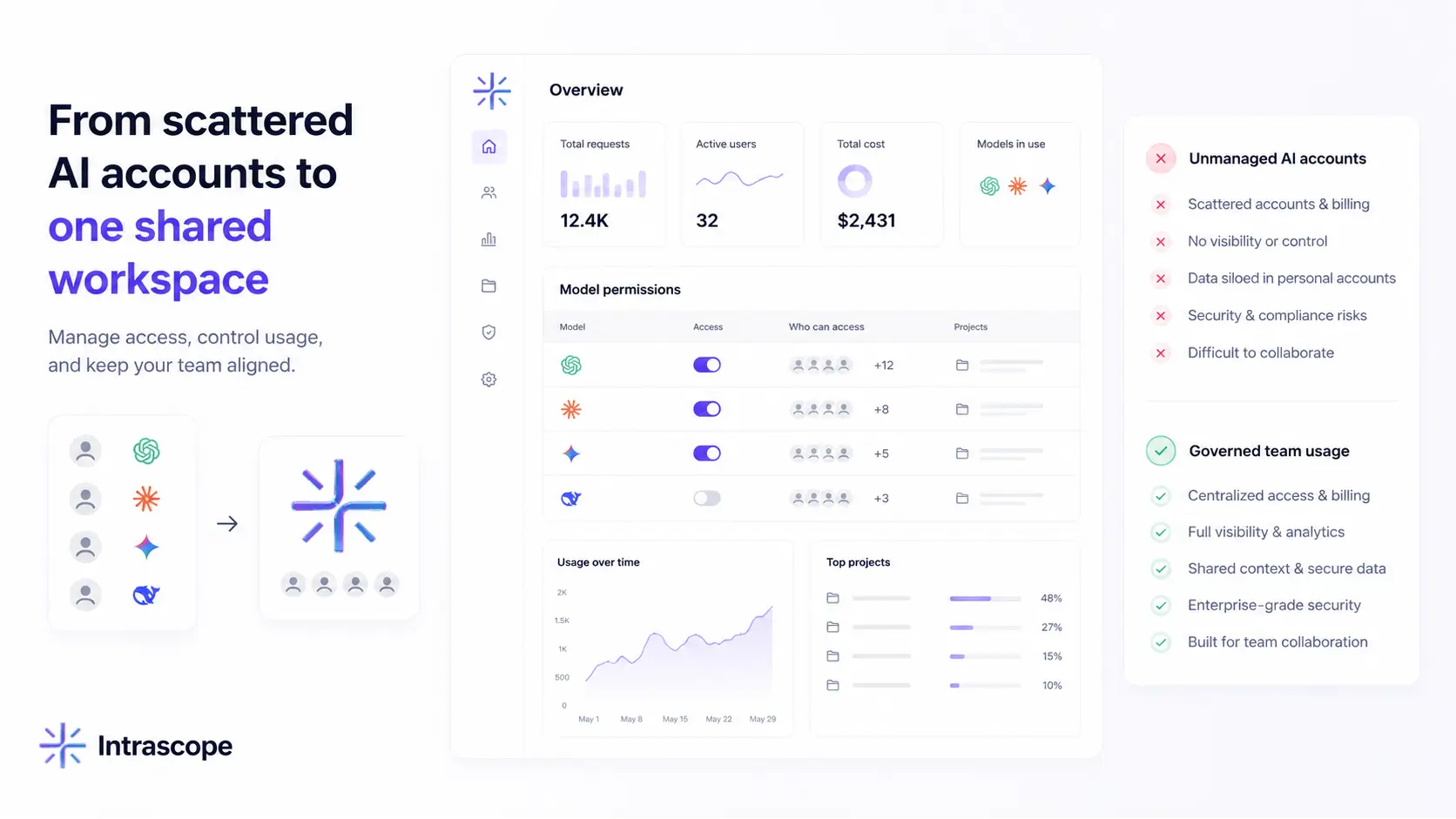
We believe the next wave of AI is not another leap in model quality alone. It is the shift from individual tools to AI governance and infrastructure: shared access, controlled usage, reusable context, and systems that keep company knowledge, cost, and accountability under control.
The first wave was generative access
Generative AI entered companies the same way spreadsheet macros, messaging apps, and cloud tools often do: from the edges. Someone tried ChatGPT. Another preferred Claude. Marketing needed drafts. Support needed faster replies. Founders saw speed and pushed it further.
That first wave was valuable. It proved usefulness. It changed expectations. It made “work with AI” normal.
It also left companies with a fragile setup:
- personal accounts instead of company infrastructure
- knowledge trapped in private chat histories
- no reliable view of who used which model, for what, or at what cost
- policies that existed on paper but not in the workflow
- premium models used for everyday tasks because no better default existed
The generative wave solved creation. It did not solve operations.
Why the next wave is infrastructure
Every serious technology eventually needs plumbing. Email needed domains and identity. Cloud needed IAM and logging. Payment systems needed ledgers and roles. Generative AI is now at that same point.
Once AI touches clients, campaigns, internal documents, and decisions, companies stop asking for magic and start asking for control:
- Where does company context live?
- Who can use which models?
- What stays inside the business when someone leaves?
- How do we pay for AI without buying unused seats?
- How do we get quality without chaos?
Those are infrastructure questions. Not model questions.
That is why we focus on a shared AI workspace for teams instead of another isolated chat experience. The next competitive advantage is not who has access to the newest model. It is who can use models reliably across the company.
Governance is not bureaucracy. It is operating system design
Many teams hear “governance” and imagine slow approvals. That is the wrong picture.
Practical AI governance for teams is closer to an operating system than a committee. It creates defaults that make good behavior easy:
- approved models available in one place
- projects that separate clients and departments
- manifests that keep shared instructions reusable
- limits that protect budget without blocking useful work
- analytics that show what is actually happening
Without that layer, every employee rebuilds the company from scratch in every prompt. With it, generative AI becomes repeatable work infrastructure instead of private experimentation.
What companies actually need in this next wave
| Need | What it looks like in practice |
|---|---|
| Shared access | One company workspace instead of personal ChatGPT and Claude accounts |
| Context infrastructure | Manifests and projects that keep knowledge inside the business |
| Model control | Admins decide what is available, and orchestration routes simple work efficiently |
| Cost infrastructure | Usage-based spend instead of empty seat pricing |
| Security and ownership | API keys, access, and context owned by the company, not private logins |
| Visibility | Usage and cost by user, project, model, and team |
This is the difference between adopting AI and operationalizing AI. We go deeper into the enterprise version of this argument in why enterprises need Intrascope.
Generative AI still matters. It just is not enough
None of this means models stop mattering. Better models will keep raising the quality ceiling. That is good. The issue is that model progress alone does not create durable company value.
A stronger model in a private account is still a private account.
A premium model used for every rewrite is still wasteful.
A brilliant answer that cannot be reused, governed, or attributed is still fragile.
The companies that win the next phase will combine generative capability with structure:
- use multiple models where each one fits, with automatic orchestration
- keep shared context in Manifests instead of chat history
- prefer API usage over seat sprawl for cost and control
- make adoption measurable with usage monitoring
We have already seen this pattern in real teams
When companies move from free or scattered generative usage into structured infrastructure, the value shows up fast. Not because people suddenly become power users, but because the system finally matches how they work.
In our first enterprise pilot, a 50-person consulting firm moved from free ChatGPT and Gemini into a governed workspace. Premium models became usable without personal subscriptions, orchestration kept waste down, and first-month API usage landed at $13.
In our marketing agency case study, an 8-person team used projects and manifests to run campaigns with shared brand context, then orchestrated models from brainstorming to final copy for $27 in month-one usage.
Those are not stories about flashier generation. They are stories about infrastructure finally catching up to generative AI.
Why this belief shaped Intrascope
We built Intrascope around this thesis from the start. Companies do not only need a place to chat with models. They need a layer that makes generative AI manageable:
- one workspace instead of shadow accounts
- BYOK or managed usage instead of seat sprawl
- projects and Manifests for shared context
- model limits and orchestration for controlled quality and cost
- analytics so leadership can actually see adoption
That is the next wave we are building for: not AI as novelty, but AI as company infrastructure.
Key takeaways
- The first wave of AI gave companies generative access. The next wave requires governance and infrastructure.
- Stronger models alone do not fix private accounts, lost context, or seat-based overspend.
- Practical governance creates defaults for access, shared context, model control, and visibility.
- Infrastructure is how generative AI becomes a durable company system instead of a personal productivity hack.
- Teams that operationalize AI early will move faster with less risk than teams stuck in scattered tools.
Conclusion
Generative AI already changed how people work. The next advantage will go to companies that treat AI like infrastructure: owned by the business, governed by defaults, measurable in usage, and flexible across models.
That is why we believe the next wave is governance and infrastructure, even for generative AI inside companies. Models create capability. Infrastructure makes capability last.
Try Intrascope free for 7 days. No credit card required. Or talk with us about building structured AI infrastructure for your team.
Intrascope for teams
Give your team one shared AI workspace instead of scattered accounts
Centralize model access, projects, manifests, and usage visibility. Try Intrascope or book a short walkthrough with our team.
7 days free · No credit card required
Closer to this topic: see how AI is used across your company.
Related articles